If you are reading this there is a good chance one of these sounds familiar.
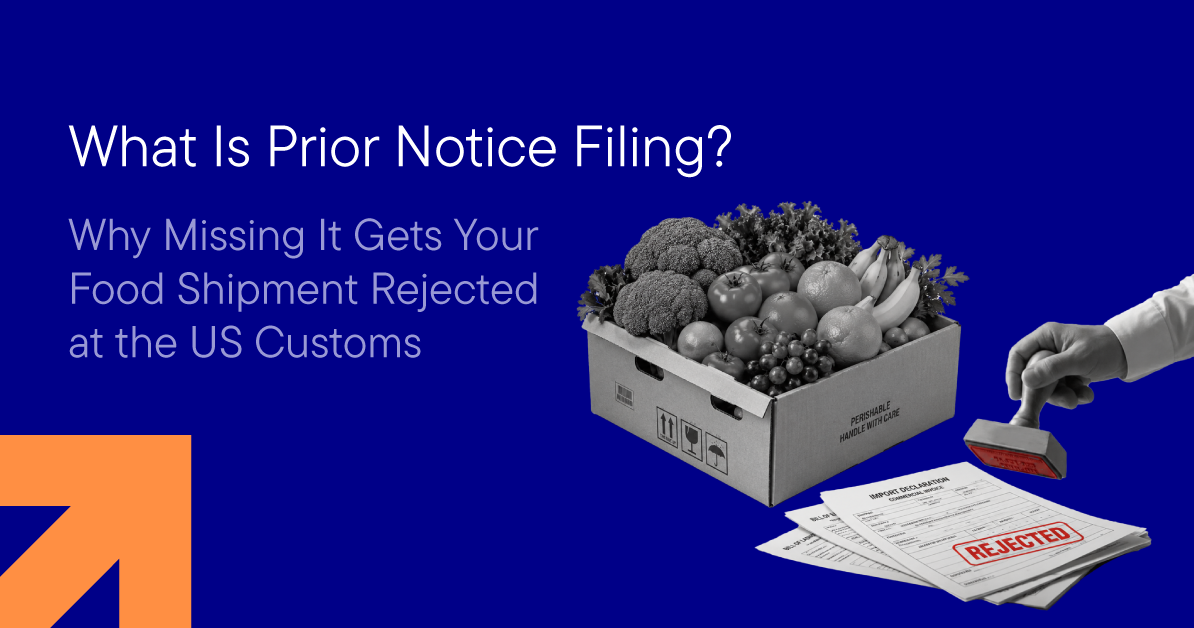
Your food shipment just got held at the US port and nobody can give you a straight answer on why.
Or your freight forwarder is telling you everything is fine but your cargo has been sitting at the port for three days.
Or maybe you are a first time food importer who has just started researching what it actually takes to get a food product into the USA — and you keep coming across the term Prior Notice without anyone explaining what it actually means.
Either way — you are in the right place.
Every food shipment entering the USA needs to be reported to FDA before it arrives. Not when it lands.
What Is Prior Notice and Why Did FDA Create It
Let's start from the beginning.
Prior Notice is simply an advance notification to FDA telling them that a food shipment is on its way to the USA.
Think of it as a heads up. You are letting FDA know what is coming, where it is coming from, who made it, and when it is going to arrive — before it actually gets there.
Before 2002 this did not exist. Food shipments came in and FDA dealt with them at the port. Then the September 11 attacks happened and everything changed.
The US government passed the Bioterrorism Act of 2002 and one of the things it introduced was Prior Notice — because the government needed to know what was entering the country before it arrived, not after.
Today every food shipment entering the USA — whether it is a full container of packaged goods or a small air freight box of specialty ingredients — needs a Prior Notice on file with FDA before it clears customs.
No exceptions. No grace period. No "we did not know." FDA does not care how long you have been importing or how many shipments you have sent before. If the filing is not there — the shipment does not move.
Which Food Products Require Prior Notice
This is the question almost every first time food importer asks — and the answer is simpler than most people expect.
Almost everything qualifies. If it is going to be consumed by people or animals in the USA — it needs a Prior Notice.
- Packaged food
- Beverages
- Dietary supplements
- Ingredients.
- Raw materials used in food production.
- Alcoholic beverages.
If it is food related and it is entering the USA — assume Prior Notice is required until someone with FDA knowledge tells you otherwise.
Here is where it gets slightly complicated. There are a few narrow exceptions. Food that is carried by an individual for their own personal use does not require Prior Notice.
Food that is produced in the USA and returning without leaving FDA jurisdiction is exempt. Certain food contact substances — the packaging and materials that touch the food rather than the food itself — do not always require filing.
But here is the important thing to understand. Those exceptions are narrow. They are specific. And if you are a commercial food importer shipping product into the USA for sale or distribution — none of those exceptions apply to you. Your shipment needs a Prior Notice. Every single time. Without exception.
When Prior Notice Must Be Submitted
This is the section that catches most food importers off guard. Because it is not just about filing Prior Notice — it is about filing it at exactly the right time.
FDA has specific windows for when Prior Notice must be submitted. Too late and your cargo gets held at the port. But here is the part most people do not know — too early and your filing expires and needs to be refiled. The window works both ways.
Here is how it breaks down by mode of transport:
Ocean freight — Prior Notice must be filed no earlier than 30 days before arrival and no later than 8 hours before the vessel arrives at the US port. For most ocean shipments this means filing while your cargo is still on the water — not when it arrives.
Air freight — No earlier than 30 days before arrival and no later than 4 hours before the aircraft lands at the US airport. For short haul flights this window can feel very tight — which is why your broker needs to be on top of the flight schedule from the moment the booking is confirmed.
Truck — No earlier than 30 days before arrival and no later than 2 hours before the truck crosses the US land border. This is the tightest window of all three modes and the one where last minute documentation delays cause the most problems.
Rail — No earlier than 30 days before arrival and no later than 4 hours before arrival at the US port of entry.
The most common mistake is leaving Prior Notice filing to the last minute because the information needed to complete it — lot numbers, manufacturer details, exact arrival time — comes from the supplier and the carrier.
If your supplier is slow sending documents and your carrier updates the arrival time, you can miss the window before you even realise it is closing.
What Information Goes Into a Prior Notice Filing
Now you know when it needs to be filed. Here is what FDA actually needs inside that filing.
This is where a lot of importers get tripped up — not because they did not file, but because what they filed was incomplete or incorrect. An incomplete Prior Notice is treated the same as no Prior Notice at all. Your cargo gets held regardless.
Here is what FDA requires:
Who is involved. The name and address of the manufacturer or processor of the food. The name and address of the shipper. The name and address of the owner of the food if different from the shipper. The name and address of the importer of record in the USA. The name and address of the ultimate consignee — the person or business receiving the food at the final destination.
What is being shipped. A complete description of the food including the FDA product code. The quantity and packaging. The lot or code numbers where applicable. The country of origin where the food was grown, manufactured, or processed.
Where it is going and when. The anticipated port of arrival into the USA. The anticipated date and time of arrival. The carrier and mode of transport. The bill of lading or air waybill number.
Every one of these fields needs to be accurate. A wrong port of arrival. A manufacturer address that does not match FDA's registration records.
A lot number that does not correspond to what is in the container. Any of these can trigger a hold — and by the time FDA flags the error your cargo is already at the port and the clock is ticking on your buyer's patience and your product's shelf life.
What Happens When Prior Notice Is Missing Late or Incorrect
Let's be very direct about this — because this is the part that matters most.
If your Prior Notice is missing, late, or incorrect when your food shipment arrives at the US port, FDA issues what is called a Notice of Action. That is the official way of saying your cargo is not going anywhere.
Here is what that actually looks like in practice.
Your shipment arrives. CBP runs a check. FDA has no valid Prior Notice on file. CBP issues a hold and your cargo cannot be unloaded or released.
Your buyer starts calling. Your product — if it is perishable — starts losing shelf life by the hour. And storage charges at the port start accumulating immediately.
If FDA determines the Prior Notice failure was a genuine mistake, you may be given an opportunity to submit the correct filing and get your cargo released. But that process takes time — time your product may not have.
If FDA decides the situation warrants a refusal of admission — which they have full authority to do for a Prior Notice violation — your options are limited.
You can re-export the goods back to the country of origin at your own cost. Or you can request that the goods be destroyed. There is no third option.
And here is the part that stings the most. A Prior Notice failure does not just affect that one shipment. FDA tracks compliance history.
An importer who has had a Prior Notice refusal is flagged in the system — and that flag means increased examination rates on every subsequent shipment. One mistake follows you for years.
Who Is Responsible for Filing Prior Notice
This is the question that causes more arguments between importers, freight forwarders, and customs brokers than almost anything else in food importing.
So let's be clear about it.
The legal responsibility for Prior Notice sits with the importer of record. That is you — the US entity bringing the food into the country.
FDA holds the importer accountable. Not the foreign supplier. Not the freight forwarder. Not the shipping line. You.
Now in practice — most importers appoint their licensed customs broker to file Prior Notice on their behalf. That is the right approach.
A customs broker who handles food imports knows the filing windows, knows what information FDA needs, and knows how to file correctly every single time.
But here is where it goes wrong. Some importers assume their freight forwarder is handling it. Some assume their foreign supplier has taken care of it.
Some assume it is somehow included in what the shipping line does. None of these assumptions are correct. A freight forwarder books your cargo. A shipping line moves it. Neither of them is responsible for your FDA Prior Notice.
The moment you assume someone else filed it — without confirming — is the moment you are one arriving shipment away from a port hold.
How to Make Sure Prior Notice Never Becomes a Problem for Your Shipments
After everything we have covered — the filing windows, the information requirements, the consequences of getting it wrong — the fix is actually straightforward.
You need three things in place before every food shipment moves.
- First — your supplier needs to send you the right information early
- Prior Notice requires manufacturer details, lot numbers, and exact product descriptions that only your supplier can provide.
- Build a pre-shipment documentation checklist that your supplier completes before the booking is confirmed — not after the cargo is already on the water.
- Second — your Prior Notice needs to be filed by someone who knows food importing
- Not a generalist freight forwarder who handles food occasionally. A licensed customs broker who works with food importers regularly and knows exactly what FDA expects in every field of that filing.
- One incorrect entry — a wrong manufacturer address, a missing lot number, a product description that does not match FDA's coding system — and your filing gets flagged.
- Third — the filing needs to happen within the right window for your specific mode of transport
- This sounds obvious. It is not. Arrival times change. Flights get rerouted. Vessels arrive early.
- Your broker needs to be monitoring your shipment's arrival window and adjusting the Prior Notice filing in real time — not filing it once and assuming it is done.
AIR7SEAS manages Prior Notice filing for food and beverage importers as part of our licensed customs brokerage service.
We coordinate with your supplier to get the right information before booking, we file within the correct window for your mode of transport, and we monitor your shipment's arrival to make sure the filing stays valid all the way to the port.
One less thing to worry about when your product's shelf life is on the line.
Frequently Asked Questions
1. What is FDA Prior Notice and why is it required for food imports?
FDA Prior Notice is a mandatory advance notification telling FDA that a food shipment is on its way to the USA. It was introduced under the Bioterrorism Act of 2002 following the September 11 attacks. Every commercial food shipment entering the USA needs a Prior Notice on file before it arrives — no exceptions. If the filing is missing, late, or incorrect your cargo cannot be released at the US port.
2. Which food products require FDA Prior Notice filing?
Almost every food product entering the USA requires Prior Notice — packaged food, beverages, dietary supplements, ingredients, raw materials used in food production, and alcoholic beverages. The only narrow exceptions are food carried by an individual for personal use and food produced in the USA returning without leaving FDA jurisdiction. If you are a commercial food importer shipping for sale or distribution — your shipment needs a Prior Notice every single time.
3. When does FDA Prior Notice need to be filed?
The filing window depends on your mode of transport. Ocean freight — no later than 8 hours before vessel arrival. Air freight — no later than 4 hours before landing. Truck — no later than 2 hours before crossing the US land border. Rail — no later than 4 hours before arrival. Filing too early is also a problem — Prior Notice filed more than 30 days before arrival expires and must be refiled.
4. What happens if FDA Prior Notice is missing or filed incorrectly?
FDA issues a Notice of Action and your cargo cannot be released. Storage charges accumulate immediately. If FDA determines the violation warrants a refusal of admission your options are re-export at your own cost or destruction of the goods. An incomplete Prior Notice is treated the same as no Prior Notice at all. One Prior Notice failure also flags your import account — resulting in increased examination rates on every future shipment
5. Who is legally responsible for filing FDA Prior Notice?
The legal responsibility sits with the importer of record — the US entity bringing the food into the country. FDA holds the importer accountable, not the foreign supplier, not the freight forwarder, and not the shipping line. In practice most importers appoint their licensed customs broker to file on their behalf. Assuming your freight forwarder or supplier has handled it without confirming is the most common reason Prior Notice filings are missed.
6. What information does FDA require in a Prior Notice filing?
FDA requires the name and address of the manufacturer, shipper, owner, importer of record, and ultimate consignee. It also requires a complete food description including FDA product code, quantity, packaging, lot numbers, and country of origin. Finally it requires the anticipated port of arrival, arrival date and time, carrier, mode of transport, and bill of lading or air waybill number. Every field must be accurate — a wrong manufacturer address or incorrect lot number can trigger a hold.
7. Can Air 7 Seas file FDA Prior Notice on my behalf?
Yes — Air 7 Seas manages Prior Notice filing for food and beverage importers as part of our licensed customs brokerage service. We coordinate with your supplier to collect the required information before booking is confirmed, file within the correct window for your specific mode of transport, and monitor your shipment's arrival to ensure the filing remains valid through to the US port. One less compliance requirement for you to manage when your product's shelf life is on the line.