Picture this: Your first big import from Mumbai—a container of premium textiles worth $75,000—sits rotting at Long Beach port, racking up $800/day fees, all because your supplier thought you handle U.S. customs clearance, while you assumed they covered insurance.
Chaos erupts in emails, lawyers get called, and your profit vanishes.
Sound familiar?
Only to solve this issue, Incoterms 2020 was introduced. It gives a clear picture of who pays what, who bears the risk when goods get damaged, and who jumps through customs hoops.
No more guesswork, no more "he said, she said.
In this blog we will give you a cheat sheet which demystifies the 11 rules, grouping them by transport mode, with risk transfer points and tips tailored for beginners importing to the U.S. from suppliers from any part of the world
Incoterms at a Glance
Incoterms 2020 consist of 11 standardized trade terms from the International Chamber of Commerce, split into two groups: 7 rules for any transport mode (air, road, rail, multimodal) and 4 for sea or inland waterway only.
Each term defines the exact point where risk shifts from seller to buyer, plus who covers costs like freight, insurance, and customs, crucial for avoiding the port chaos in your intro.
Key 2020 updates include replacing DAT with DPU (now for all modes), CIP requiring stronger insurance coverage, and FCA allowing buyers to handle the Bill of Lading if needed.
Sea and Inland Waterway Rules
These four Incoterms: FOB, CFR, CIF, and FAS.
They apply only to ocean or inland waterway shipments, like your Mumbai-to-Long Beach container. They're seller-favored for exports but risky for new importers if you misjudge costs post-handover.
Risk always flips at a port, and sellers typically handle export clearance from origin (e.g., India).
- FAS (Free Alongside Ship): Seller delivers goods alongside the ship at the origin port (e.g., "FAS Chennai Port") but does not load them. Buyer handles loading, ocean freight, insurance, import customs, and duties; risk transfers once goods are placed alongside the ship. Best for bulk cargo like grain; rarely used for containers and not ideal for beginners due to loading complexities.
- FOB (Free On Board): Seller clears for export and loads goods onto the ship at origin (e.g., "FOB Mumbai JNPT"); buyer pays ocean freight, insurance, unloading, and import duties. Risk transfers once goods are on board; popular with importers for freight control, forwarder choice, and transparent pricing.
- CFR (Cost and Freight): Seller pays ocean freight to destination port (e.g., "CFR Los Angeles") and loads at origin; buyer covers insurance, unloading, and customs/duties. Risk shifts at origin loading despite seller-paid freight—insure separately to avoid losses from sea damage, and watch for hidden freight costs in supplier pricing.
- CIF (Cost, Insurance and Freight): Seller handles freight, basic marine insurance, and origin loading to destination port (e.g., "CIF Los Angeles"); buyer manages unloading, duties, and often upgrades insurance. Risk transfers at origin loading; seller's minimal coverage (e.g., Institute Cargo Clauses C) requires verifying insured value matches your exposure.
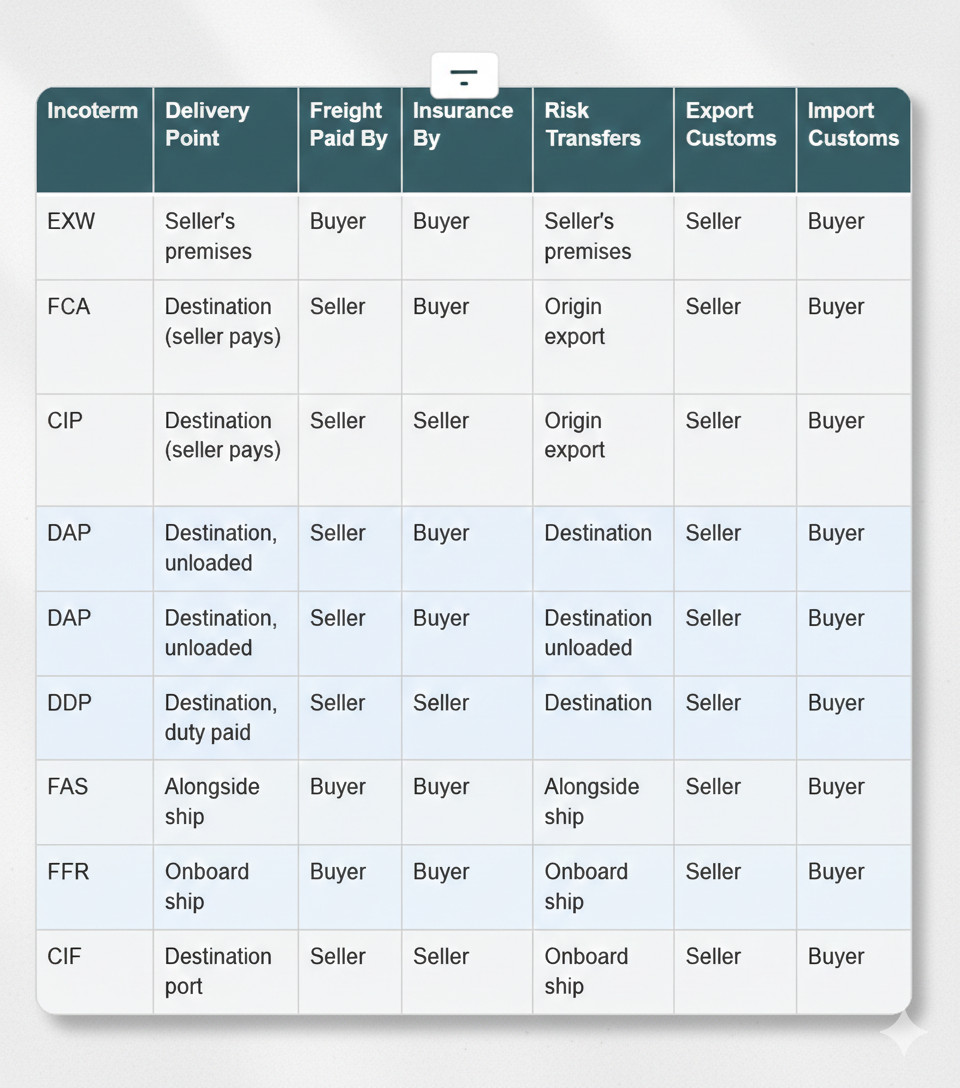
Comparison sheet
All-Modes Rules (Air, Road, Rail, Multimodal)
These 7 Incoterms work for any transport—perfect for air freight from Delhi to L.A. or truck shipments.
No ocean vessel needed. Seller often handles origin export (e.g., India DGFT clearance), but risk shifts earlier than sea terms. Ideal for faster, smaller imports like electronics or samples.
- EXW (Ex Works): The seller's responsibility ends at their premises; the buyer manages loading, transport, export clearance, and all risks/costs from there. Ideal for buyers with strong local logistics control, but risky for newcomers due to full origin handling.
- FCA (Free Carrier): Seller delivers goods, cleared for export, to the buyer's carrier at a named place; risk transfers upon handover. Flexible for containers—specify if at seller's site or terminal; preferred over FOB for non-sea routes.
- CPT (Carriage Paid To): Seller arranges and pays main carriage to the destination named place but risk passes to buyer once goods are handed to the first carrier. Buyer handles import clearance and unloading; useful when seller controls outbound freight.
- CIP (Carriage and Insurance Paid To): Mirrors CPT, but seller must provide minimum insurance coverage (Institute Cargo Clauses A) until destination. Offers importers some protection; specify higher coverage if needed for high-value goods.
- DAP (Delivered at Place): Seller bears all transport risks/costs to deliver goods ready for unloading at the named destination; buyer handles import duties and unloading. Great for importers wanting minimal hassle short of full seller responsibility.
- DPU (Delivered at Place Unloaded): Like DAP, but seller also unloads at destination (replacing DAT from 2010 for clarity across modes). Risk transfers post-unloading; suits importers without on-site equipment.
- DDP (Delivered Duty Paid): Seller assumes maximum obligation—transport, risks, export/import clearance, duties, and delivery to buyer's premises. Easiest for new importers but costliest, as sellers often add premiums.
Common Mistakes to Avoid
New importers often stumble with Incoterms, leading to surprise costs, delays, or lost cargo—here's how to sidestep the pitfalls using Incoterms 2020.
- Using outdated 2010 terms: Always specify "Incoterms 2020" in contracts; DAT became DPU, and ignoring this causes confusion on unloading duties.
- Picking FOB for all containers: FOB suits breakbulk but FCA is better for containers—FOB risks seller delays in loading, while FCA lets you control the carrier.
- Skipping insurance in CFR/CPT: Seller pays freight but risk shifts early; CFR/CPT buyers must insure separately, or sea damage falls on you despite seller-paid transport.
- Over-relying on DDP: Sellers inflate prices with their duty estimates—new importers lose negotiation power; prefer DAP to handle your own customs for savings.
- Vague place names: "FOB India" fails—specify "FOB Mumbai JNPT" to avoid disputes on exact delivery/risk points.
- Ignoring mode rules: Don't apply sea-only terms (FAS/FOB/CFR/CIF) to air shipments; stick to any-mode terms like FCA/CIP for multimodal routes.
- Not consulting forwarders: Assumptions kill—get Air7Seas or experts to review terms matching your supply chain before signing.
Choosing the Right Incoterm
New importers can select Incoterms 2020 by balancing control, cost, and risk—start with your transport mode and experience level for the best fit.
- Match transport mode first: Use any-mode terms (EXW, FCA, CPT, CIP, DAP, DPU, DDP) for air, road, or multimodal; limit sea-only (FAS, FOB, CFR, CIF) to ocean shipments from ports like Chennai.
- Assess your experience: Beginners favor seller-heavy terms like CIP, DAP, or DDP to minimize logistics; experienced importers pick FCA or CPT for freight control and savings.
- Evaluate risk tolerance: Early risk transfer (EXW, FCA) suits trusted suppliers; later transfer (DAP, DPU) protects against transit issues but raises seller costs.
- Consider customs and duties: DAP/DDP shift import burdens—choose DAP if you handle U.S. clearance efficiently, DDP if seller expertise outweighs premiums.
- Factor in cargo type: Bulk cargo leans FOB/FAS; containers prefer FCA/CIP; high-value goods need CIP/DDP insurance.
- Negotiate specifics: Always add "Incoterms 2020 [exact place]" (e.g., "DAP Los Angeles Warehouse") and consult forwarders like Air7Seas for quotes under 2-3 options.

Conclusion
Don't let another $75K shipment turn into a port-side horror story, Incoterms 2020 are your shield against chaos, locking in crystal-clear roles for costs, risks, and customs so profits roll in, not lawyers' bills.
You've mastered the cheat sheet: Sea terms like FOB for ocean control, all-modes like FCA/CIP for air flexibility, pitfalls dodged, and smart picks tailored to your U.S. imports from anywhere across the globe.
Power Moves for Your Next Deal
- Print this cheat sheet—bookmark risk flips and duties tables.
- Test it: Quote FCA vs. CIF with your forwarder—save 15-25% instantly.
- Pro upgrade: Pair with U.S. customs docs (our last blog) for zero delays.
For personalized guidance on applying these to your next U.S. import, consider reaching out to Air7Seas, we are specialized in reliable air and sea logistics.
Frequently Asked Questions
1. What is the main difference between FOB and CIF for new US importers?
FOB shifts risk once goods are on board at origin port (e.g., Mumbai), letting you control freight; CIF includes seller-paid freight+basic insurance to your port, but risk still flips early—always verify coverage matches your $75K cargo value.
2. Can I use sea Incoterms like FOB for air shipments from India?
No—FOB/CFR/CIF/FAS are sea-only; use FCA or CIP for air from Delhi to L.A. to avoid contract disputes and ensure proper risk transfer at carrier handover.
3. When using EXW, what risks do first-time importers face?
Max exposure: You handle export clearance (India DGFT), loading, all freight/insurance. Stick to FCA if you're new—seller clears exports, reducing Chennai logistics headaches.
4. How do I specify Incoterms 2020 correctly in contracts?
Always write "FCA Chennai Airport, Incoterms® 2020"—exact place + year prevents "FOB India" vagueness that triggers port delays like your $800/day Long Beach nightmare.
5. What's the best Incoterm for beginners importing containers to USA?
FCA for sea containers (control forwarder, save 15-20%) or CIP for air/high-value goods (seller insures). Test quotes via Air7Seas to match your Mumbai→NYC route.