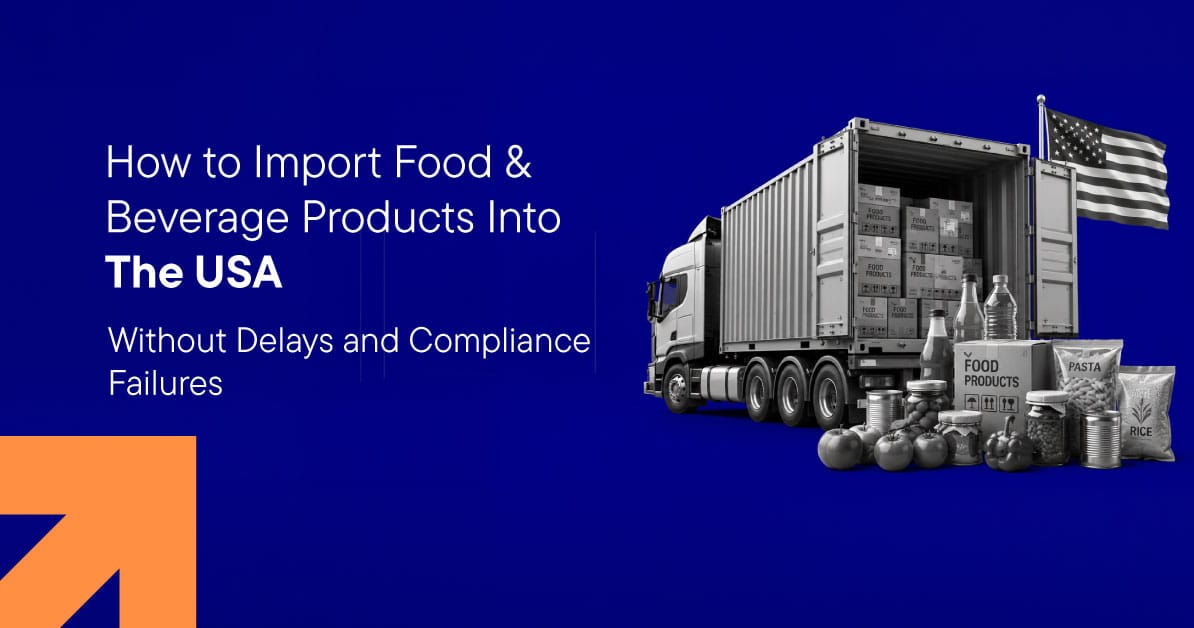
You found the supplier. The product is good. The price works.
You book the shipment and you're thinking this is straightforward. Then the FDA flags your cargo at the port because your supplier's facility isn't registered in the right system.
Or USDA puts a hold on your shipment because a permit application that takes six weeks to process wasn't filed before the goods left origin.
Or your reefer container arrives two degrees outside the acceptable range and an entire load of product is now unsellable.
This happens to food and beverage importers constantly — not because they made obvious mistakes, but because nobody walked them through what US regulators actually require before a shipment moves.
In this blog we cover every step — FDA, USDA, customs, cold chain, labeling, supplier compliance — so your next shipment gets through without the surprises.
Step 1 — Get Your FDA Requirements Sorted Before Your Supplier Ships Anything
Here is where most food and beverage importers get caught out — not because the FDA requirements are unreasonable, but because they don't find out about them until it's too late to fix anything.
There are three things the FDA needs from you before a food or beverage shipment can legally enter the US.
- Prior Notice
- Every food shipment entering the US must be reported to the FDA before it arrives. Not when it arrives — before.
- FDA needs to know what's coming, who made it, where it's coming from, and what port it's entering through.
- File it too late and FDA can refuse the shipment entry entirely.
- Food Facility Registration
- The foreign facility that manufactured or processed your product must be registered with the FDA.
- This isn't a one-time setup — registrations need to be renewed every two years during even-numbered years.
- If your supplier's registration has lapsed and you don't catch it before the shipment moves, FDA will not allow your goods to enter.
- FSVP — Foreign Supplier Verification Program
- As the US importer, you are legally responsible for verifying that your foreign supplier is producing food in a way that meets US safety standards.
- That means documented supplier evaluations, hazard analysis, and ongoing monitoring.
- Most first-time importers have never heard of FSVP until FDA asks for their records.
Get all three in order before your supplier confirms the booking. Everything else in this guide becomes significantly harder if the FDA has a problem with your shipment before it even arrives.
Step 2 — Identify Whether Your Product Needs a USDA Permit and Apply Early
If FDA is the agency most food importers forget about, USDA is the one that surprises them the most. Because unlike FDA — where the requirements apply broadly across most food categories — USDA requirements are product specific.
And if your product falls under USDA jurisdiction, the permit process has a timeline that won't bend for your shipment schedule.
Here's how to know if USDA applies to you.
- USDA FSIS covers meat, poultry, and egg products. If you're importing any of these, your foreign supplier's facility must be on USDA's approved establishment list — meaning it has been inspected and certified by the equivalent food safety authority in the country of origin and that authority has an equivalence agreement with the US. If your supplier isn't on that list, your product cannot enter the US. Full stop.
- USDA APHIS covers fresh fruits, vegetables, plants, and certain dairy products. These shipments require a phytosanitary certificate issued by the national plant protection authority in the country of origin, certifying the product is free from pests and disease. Some products also require an import permit issued by APHIS before the shipment moves.
Here's where importers consistently go wrong — they find out their product needs a USDA APHIS import permit after the shipment is already booked.
APHIS permit applications can take anywhere from two to six weeks to process depending on the product and country of origin. Your shipment will not clear customs without it.
Apply early. Confirm your supplier's certification status before you place the order.
And if you're unsure which USDA agency covers your product, that's exactly the kind of question a licensed customs broker with food and beverage experience can answer before it becomes a port problem.
Step 3 — Classify Your Product Correctly Before You Calculate Your Landed Cost
Most food and beverage importers calculate their landed cost based on the freight quote and a rough duty rate someone looked up online.
That number is almost always wrong — and in food and beverage, it's wrong in ways that are more expensive than most other categories.
Here's why food and beverage HTS classification is more complicated than it looks.
- Tariff Rate Quotas
- Certain food and beverage products — dairy, sugar, peanuts, tobacco, certain meats — have tariff rate quotas.
- This means a specific volume of that product can enter the US at a low duty rate. Once that quota is filled, the duty rate jumps — sometimes dramatically.
- An importer who doesn't know their product is subject to a TRQ can budget for a 5% duty rate and end up paying 40% because the quota was already filled when their shipment arrived.
- Seasonal Duty Rates
- Some fresh fruits and vegetables carry different duty rates depending on the time of year.
- A product that's 0% duty in the off-season can carry a meaningful duty rate during domestic harvest periods when US growers are being protected.
- If your freight schedule doesn't account for seasonal rate changes, your landed cost model will be off.
- ADD and CVD Exposure
- Antidumping and countervailing duty orders exist on certain food products from specific countries — honey, garlic, mushrooms, certain seafood from China being well-known examples.
- If your product and country of origin fall under an active order, the additional duty can be several times your base rate.
- A wrong HTS code that misses an ADD flag isn't just a classification error — it's a financial exposure that compounds across every entry you file.
Get your HTS codes reviewed by a licensed customs broker before you finalize your supplier pricing. The duty rate isn't a footnote in your landed cost — it's often the difference between a margin that works and one that doesn't.
Step 4 — Make Sure Your Product Label Is CBP and FDA Compliant Before It Leaves the Factory
This is the step that feels like a detail until it isn't. A non-compliant food label doesn't just get flagged at customs — it can trigger a detention, a refused entry, or in the worst case a recall after the product has already entered US commerce.
And fixing a label problem after the goods have been manufactured and packed is expensive, time consuming, and sometimes impossible without destroying the product entirely.
Here is what needs to be on your label before the goods leave the factory.
- FDA Labeling Requirements
- Every food and beverage product entering the US needs a nutrition facts panel in the correct FDA format, a complete ingredient list in descending order by weight, an allergen declaration covering the nine major US allergens — milk, eggs, fish, shellfish, tree nuts, peanuts, wheat, soybeans, and sesame — and a net quantity statement in both metric and US customary units.
- Foreign manufacturers who export to multiple markets often have a version of a compliant label — but compliant for the EU or Canada is not the same as compliant for the US.
- Bioengineered Food Disclosure
- If your product contains bioengineered ingredients — commonly known as GMOs — US law requires a specific disclosure on the label.
- This applies to a broader range of ingredients than most importers expect, and the disclosure format has specific requirements around language and symbols that need to be verified before production.
- Country of Origin Labeling
- Certain food categories — fresh fruits and vegetables, fish and shellfish, muscle cuts of meat — require country of origin labeling under USDA regulations.
- The format and placement requirements are specific. Getting this wrong doesn't just create a customs problem — it creates a retail compliance problem after the product has already been cleared.
Send your label artwork to a customs broker or trade compliance specialist for review before you approve production. One revision at the artwork stage costs almost nothing.
One revision after 10,000 units are already packed and on the water is a very different conversation.
Step 5 — Verify Your Foreign Supplier Meets US Food Safety Standards
Most importers think supplier verification means making sure their supplier can deliver on time and hit the right price point. Under US law it means something very different — and the importer is the one responsible for proving it.
The Foreign Supplier Verification Program requires every US food importer to verify that the foreign facilities producing their food are manufacturing it in a way that meets US food safety standards.
This isn't optional and it isn't something you can delegate entirely to your supplier. The responsibility sits with you as the importer of record.
Here is what FSVP actually requires you to have documented.
- A hazard analysis for each product you import
- You need to identify the food safety hazards associated with your specific product — biological, chemical, physical — and determine what controls your supplier has in place to address them.
- This isn't a generic checklist. It's product specific and supplier specific.
- Supplier verification activities
- Depending on the hazard profile of your product, verification can take different forms — onsite audits of the foreign facility, review of the supplier's food safety records, third party audit certificates, or end product testing.
- The method you use needs to be documented and appropriate for the risk level of the product.
- Ongoing monitoring
- FSVP isn't a one-time exercise. You need to reassess your suppliers periodically — and immediately if something changes, like a new facility, a new ingredient source, or a food safety incident at the supplier's end.
If the FDA walks into your office for an FSVP inspection and you don't have this documentation in order, the conversation gets expensive very quickly.
Build the program before your first shipment moves — not after the FDA asks to see it.
Step 6 — Choose the Right Freight Mode and Protect Your Cold Chain
Getting your FDA paperwork right, your USDA permits in order, and your labels compliant means nothing if your product arrives at the US port outside the required temperature range.
Cold chain failure is one of the most expensive problems in food and beverage importing — because by the time you find out something went wrong, the damage is already done and the product is often unsalvageable.
Here is how to make the right freight decisions for temperature sensitive food and beverage products.
- Air freight vs ocean freight.
- For highly perishable products with a short shelf life — fresh produce, certain dairy, live seafood — air freight is often the only viable option regardless of the cost premium.
- The transit time on ocean freight simply doesn't work when your product has a 14 day shelf life. For shelf stable or frozen products where transit time is less critical, ocean freight in a reefer container is the standard approach.
- The decision isn't just about cost — it's about whether your product can survive the transit time.
- Reefer container management
- If you're shipping in a reefer container, the temperature needs to be set correctly before loading and monitored throughout the journey.
- A reefer unit that malfunctions mid-voyage without anyone noticing until the container is opened at the destination port is a total loss scenario.
- Work with a freight forwarder who actively monitors reefer performance throughout the transit — not one who books the container and considers their job done.
- Last mile is where cold chains most commonly fail
- The ocean transit gets the most attention but the highest risk point is often the last mile — the transfer from the port to your warehouse or distribution center.
- A temperature excursion during a two hour trucking leg after a successful three week ocean transit is more common than most importers expect.
- Make sure your domestic trucking partner is equipped and certified for temperature controlled freight before you assume the cold chain is covered end to end.
Air 7 Seas manages temperature sensitive food and beverage freight across air, ocean, and ground — with reefer monitoring throughout the transit and cold chain certified domestic delivery.
If your product needs to arrive in the same condition it left the factory in, that's a conversation worth having before you book your next shipment.
Step 7 — Have a Licensed Customs Broker Managing Your Entry Before Your Cargo Arrives
Everything covered in this guide — FDA filings, USDA permits, HTS classification, label compliance, supplier verification, cold chain management — comes together at one point.
Customs clearance. And if anything in that chain has a gap, this is where it surfaces.
A licensed customs broker doesn't just file your entry paperwork. For food and beverage importers specifically, they are the person coordinating between CBP, FDA, and USDA on your behalf — making sure the right filings are in place, the right documentation is ready for examination, and any agency hold gets resolved as quickly as possible.
Here is what a customs broker is actively managing on every food and beverage entry.
- Prior Notice coordination
- Making sure FDA's Prior Notice is filed within the correct window before your cargo arrives — not after it's already at the port waiting.
- PGA flag management
- When FDA or USDA flags your entry for review, your broker is the one communicating with the agency, providing requested documentation, and pushing for release.
- Without a broker, you're navigating that conversation yourself — in a language most importers don't speak fluently.
- Entry accuracy
- Your HTS code, your declared value, your country of origin — all reviewed before the entry is filed, not discovered to be wrong during a CBP examination.
- Tariff rate quota monitoring
- If your product is subject to a TRQ, your broker tracks quota availability and times your entries to make sure you're filing within the low duty window — not after the quota has been filled.
The difference between a food and beverage importer who clears customs smoothly and one who is constantly dealing with holds and delays usually comes down to one thing — who is managing their entries.
Air 7 Seas handles customs brokerage specifically for food and beverage importers, coordinating with FDA and USDA on every entry so your shipments move without the surprises that cost time and money at the port.
The Bottom Line
Food and beverage importing has more moving parts than almost any other import category. FDA, USDA, CBP, cold chain, labeling, supplier compliance — each one is a checkpoint that can stop your shipment if it isn't handled correctly.
The importers who get this right aren't necessarily the largest or most experienced. They're the ones who built the right process upfront and put the right partner in place to manage it.
Every delay, every hold, and every compliance failure in this guide is avoidable — with the right preparation and the right broker on your entries.
Air 7 Seas manages freight forwarding and licensed customs brokerage for food and beverage importers — air, ocean, and ground, with full FDA and USDA coordination on every shipment.
If you're importing food and beverage products into the US and want a partner who knows this category inside out, let's talk.
Frequently Asked Questions
1. Do all food and beverage products require FDA Prior Notice?
Yes — virtually all food products entering the US require Prior Notice to be filed with FDA before the shipment arrives. The only exceptions are food carried by an individual for personal use and certain domestically produced products returning to the US. For commercial food imports, Prior Notice is mandatory without exception.
2. How far in advance does FDA Prior Notice need to be filed?
The timing depends on the mode of transport. For ocean freight, Prior Notice must be filed between 8 hours and 30 days before the estimated arrival at the US port. For air freight, the window is between 4 hours and 30 days before arrival. For truck shipments crossing a land border, it's between 2 and 30 days. Filing outside these windows — too early or too late — means the filing is invalid and must be refiled.
3. What is the difference between USDA FSIS and USDA APHIS for food importers?
USDA FSIS — Food Safety and Inspection Service — regulates meat, poultry, and egg products. USDA APHIS — Animal and Plant Health Inspection Service — regulates fresh fruits, vegetables, plants, and certain dairy and animal products. Some products fall under both agencies. Knowing which agency covers your specific commodity determines what permits, certificates, and compliance requirements apply before your shipment moves.
4. What happens if my food shipment is detained by FDA at the port?
FDA issues a Notice of Action detaining the shipment. You have the right to submit testimony contesting the detention and to have the product sampled and examined. If FDA determines the product is in violation — contamination, labeling non-compliance, missing registrations — they can issue a refusal of admission. Refused shipments must be re-exported or destroyed. Detention hold periods vary but demurrage and storage charges accumulate throughout.
5. What is a Tariff Rate Quota and how does it affect food and beverage importers?
A Tariff Rate Quota allows a specific volume of a product to enter the US at a lower duty rate. Once that volume threshold is reached for the year, all subsequent imports of that product pay the over-quota rate — which can be significantly higher. TRQs apply to products like dairy, sugar, peanuts, and certain meats. Importers who don't track quota availability can find themselves paying a duty rate several times higher than they budgeted for.
6. How do I know if my food product contains bioengineered ingredients that require disclosure?
The USDA National Bioengineered Food Disclosure Standard requires disclosure for products that contain detectable genetic material that has been modified through certain laboratory techniques. The list of regulated bioengineered foods includes products like corn, soybeans, canola, sugar beets, and papaya among others. If your product contains ingredients derived from these commodities, you need to assess whether a bioengineered food disclosure is required before your label goes to production.
7. Can I use the same freight forwarder for both food and non-food imports?
Technically yes — but practically, it depends entirely on whether your freight forwarder understands food and beverage compliance. A generalist forwarder who doesn't know FDA Prior Notice requirements, USDA permit timelines, or cold chain management for perishable goods will cost you more in delays and compliance failures than any rate savings justify. Food and beverage importing requires a partner who knows the category — not one who treats it like any other commodity.