If you’ve ever received an air freight quote and thought, “Wait… how did they calculate that weight?” — you’re not alone.
Air freight pricing can feel confusing at first. You weigh your shipment, get a number in kilograms, and assume that’s what you’ll be charged for.
But then you hear terms like volumetric weight, dimensional weight, and chargeable weight, and suddenly things get complicated.
In this guide, we’ll break it down step by step without any complicated jargon, just clear explanations and practical examples you can actually use.
What is Chargeable Weight in Air Freight?
Alright, now let’s clear up the main term.
Chargeable weight is the weight airlines use to calculate how much you’ll pay for your shipment. And here’s the important part:
Chargeable weight is whichever is higher — the actual weight or the volumetric weight.
That’s it. Simple rule.
Let’s break that down quickly:
- Actual weight = The real physical weight of your cargo (in kg).
- Volumetric weight = The weight calculated based on how much space your cargo occupies.
- Chargeable weight = The higher value between the two.
Why does this matter?
Because space on an aircraft is limited and expensive. A lightweight but bulky shipment can take up the same space as a heavy shipment. So airlines make sure they’re compensated for both weight and space.
In one sentence:
Air freight is charged based on space or weight — whichever costs more.
In the next section, we’ll look at the exact formula airlines use so you can calculate it yourself.
How Do You Calculate Chargeable Weight?
Let’s keep this simple and straight to the point.
Here’s exactly how you calculate chargeable weight for air freight:
Step 1: Measure the Dimensions
- Measure the length × width × height of your package in centimeters.
Step 2: Calculate Volumetric Weight
Use this standard air freight formula:
- Volumetric Weight (kg) = Length × Width × Height (cm) ÷ 6000
(Some airlines may use 5000, but 6000 is the most common standard.)
Step 3: Check the Actual Weight
- Weigh your shipment to get the gross weight in kilograms.
Step 4: Compare Both Weights
- Whichever is higher becomes your chargeable weight.
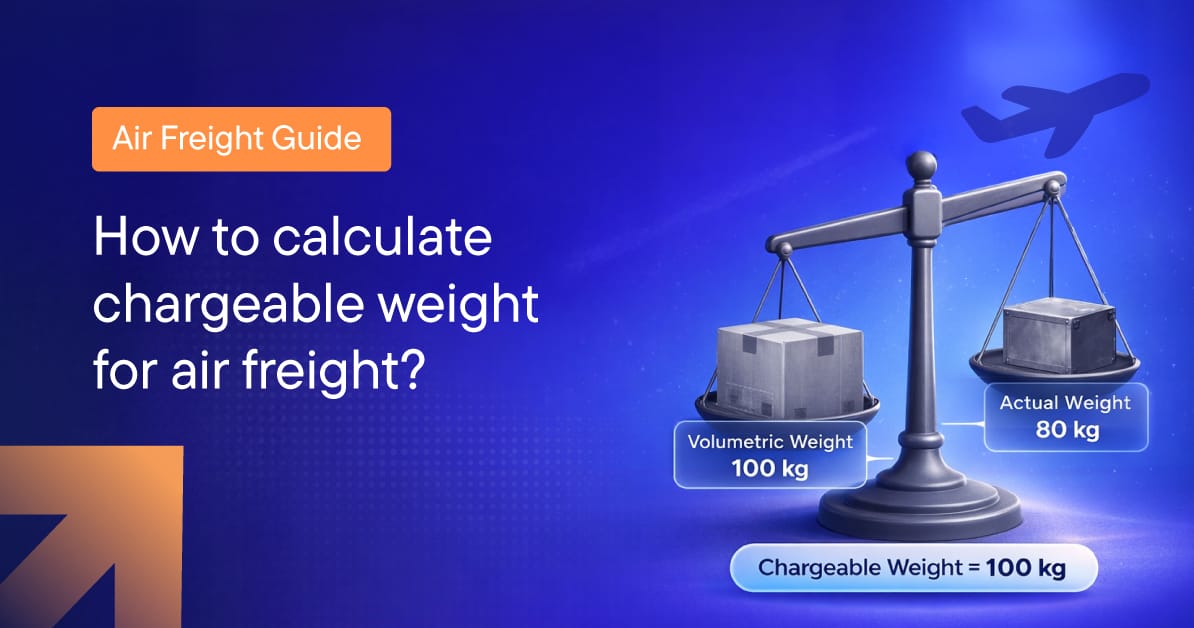
Simple Example:
- Actual weight = 80 kg
- Volumetric weight = 100 kg
Your chargeable weight = 100 kg
Difference between actual weight and volumetric weight
Actual Weight (Gross Weight)
This one’s straightforward.
Actual weight is the real, physical weight of your shipment when placed on a scale.
It includes:
- The product
- The packaging
- The pallet (if applicable)
- Any additional wrapping or materials
So if you put your cargo on a weighing scale and it shows 120 kg, that’s your actual weight.
👉 If your shipment is small but very heavy (like metal parts or machinery components), the actual weight will usually be higher than the volumetric weight — and that becomes your chargeable weight.
Volumetric Weight (Dimensional Weight)
This is where things get interesting.
Volumetric weight is calculated based on how much space your cargo takes up in the aircraft — not how heavy it is.
Airlines use this because aircraft space is limited. A shipment filled with pillows might weigh very little, but it could take up a lot of valuable cargo space.
That’s why they use this formula:
Volumetric Weight (kg) = Length × Width × Height (cm) ÷ 6000
The larger the dimensions, the higher the volumetric weight — even if the shipment is light.
👉 If your shipment is lightweight but bulky (like furniture, plastic items, or cartons of apparel), the volumetric weight will likely be higher than the actual weight.
The Golden Rule (Again)
- Heavy & compact cargo → Actual weight wins
- Light & bulky cargo → Volumetric weight wins
And whichever wins becomes your chargeable weight.

Why Does the Volumetric Weight Formula Differ?
If you’ve ever compared quotes and noticed one company using 6000 and another using 5000, you’re probably wondering what’s going on.
Let’s clear it up.
Why 6000 Is Common in Standard Air Freight
The divisor 6000 is the traditional standard used in international air cargo.
It’s widely applied in general cargo shipments handled by airlines following guidelines from the International Air Transport Association (IATA).
When 6000 is used:
- Volumetric weight is slightly lower
- It benefits shippers with bulky but lightweight cargo
- It reflects standard aircraft space-to-weight conversion (1 CBM ≈ 167 kg)
- Most regular airport-to-airport air freight shipments use this factor.
Why 5000 Is Sometimes Used
Some airlines and many express courier companies like DHL, FedEx, and UPS use 5000 instead of 6000.
When 5000 is used:
- Volumetric weight becomes higher
- Chargeable weight increases
- Bulky shipments become more expensive
This usually happens because:
- Express services use faster networks
- Operating costs are higher
- Space is optimized differently
- Door-to-door services are included
The Key Difference in Simple Terms
Let’s say your shipment volume equals 1 cubic meter:
- Using 6000 divisor → Volumetric weight ≈ 167 kg
- Using 5000 divisor → Volumetric weight = 200 kg
That’s a 33 kg difference — which directly affects your freight cost.
What You Should Always Do
Before booking cargo, confirm:
- Which divisor is being used (6000 or 5000)
- Whether rounding rules apply
- If the shipment is standard air freight or express courier
Because a small divisor difference can significantly change your final chargeable weight.
Chargeable Weight vs Actual Weight vs Volumetric Weight
Here’s a simple side-by-side comparison to remove any confusion:

The key takeaway?
Always calculate your chargeable weight in advance. Measure properly, confirm the divisor, and compare both weights before requesting a quote.
A few minutes of calculation can save you from unexpected costs — and help you plan smarter shipments every time.
Frequently Asked Questions
1. Can I reduce chargeable weight?
Yes. You can reduce chargeable weight by:
- Using compact packaging
- Removing unnecessary void space
- Optimizing carton dimensions
- Avoiding oversized pallets
Reducing volume lowers volumetric weight, which may reduce your freight cost.
2. Is chargeable weight always rounded up?
Yes, most airlines round up to the next half kilogram or full kilogram, depending on their policy. Even if your calculated weight is 100.2 kg, it may be billed as 101 kg. Always confirm rounding rules with your freight forwarder.
3. What is chargeable weight in air freight?
Chargeable weight is the weight airlines use to calculate freight charges. It is the higher value between actual weight and volumetric weight. Airlines compare both and charge based on whichever is greater to account for both cargo weight and space occupied.
4. How do you calculate chargeable weight?
To calculate chargeable weight:
- Measure length × width × height (in cm).
- Divide by 6000 to get volumetric weight.
- Compare volumetric weight with actual weight.
- The higher value is the chargeable weight.
Formula:
(L × W × H in cm) ÷ 6000
5. Why do airlines use volumetric weight?
Airlines use volumetric weight because aircraft space is limited and expensive. Lightweight but bulky cargo can take up significant space. Volumetric weight ensures airlines are compensated for the space used, not just the physical weight of the shipment.
6. What is the standard volumetric divisor in air freight?
The standard volumetric divisor in international air freight is 6000. This means 1 cubic meter equals approximately 167 kg. However, some airlines and courier companies may use 5000, which increases the chargeable weight.