
Before we dive in — forget cheapest. The shippers who win are the ones who ship smarter.
Shipping from the US to the Philippines shouldn't cost more than what's inside the box.
Whether you're sending a Balikbayan box to your family, mailing a small package, or shipping products to Filipino customers — there's always a cheaper way to do it. You just need to know where to look.
This guide breaks down the best and most affordable shipping options in 2026, so you stop overpaying and start shipping smarter.
Let's get into it.
Know Your Shipping Type First
Not all shipments are the same — and the cheapest option for one person might be the worst choice for another. Before comparing prices, figure out which category you fall into:
- Sending a Balikbayan box to family — You're packing clothes, snacks, household items, or pasalubong for loved ones back home. Sea cargo is almost always your best bet here.
- Sending a small parcel or document — Think lightweight packages under 5 lbs. Budget air carriers and USPS are your go-to options.
- Shipping large or heavy freight — Furniture, appliances, or bulk commercial goods. Ocean freight via cargo forwarders will save you the most money.
- eCommerce sellers shipping to Philippine customers — You need reliability and tracking above all. Courier aggregators like Easyship or Parcel Monkey help you find the best rate per order.
Know your type and the rest of this guide becomes a lot easier to navigate. Jump straight to the section that matches your situation — or read through all of them to find hidden savings you didn't expect.

The Cheapest Shipping Options from USA to Philippines (2026)
For Balikbayan Boxes — Best Value for Bulk
- If you're sending a box full of goods to your family, sea cargo is the most affordable route. Standard rates start at around $50–$150 per box with delivery in 30–70 days.
- The savings are significant compared to air — but the real trick is consolidation. When multiple shipments heading to the same destination are grouped together, the cost per box drops considerably.
- This is something individual shippers rarely have access to on their own.
For Small to Mid-Size Packages — Best Budget Air
- For packages under 5 lbs, budget air options can start as low as $14–$27. But as weight increases, so does the rate.
- Many shippers are surprised to find that how they book their shipment matters just as much as which carrier they use.
- Booking through someone with established carrier relationships often yields better rates than walking up to a counter directly.
For Heavy Freight and Commercial Shipments — Ocean Freight
- For bulk goods, business inventory, appliances, or furniture, ocean freight is the most cost-effective option with average transit times of 31 days from the USA to the Philippines.
- The challenge most shippers face here isn't the shipping itself — it's the customs documentation, import duties, and coordinating pickup and last-mile delivery on the Philippine end. Getting all of that wrong can cost more than the shipping itself.
For Urgent Shipments — Air Freight
- When timing is critical, air freight delivers in 3–5 business days. Express couriers are the most well-known option, but they're not always the most economical for heavier shipments.
- Rates vary widely depending on how and where you book — so comparing your options before committing is always worth the extra ten minutes.
The Smarter Way Most People Overlook
- Standard couriers are convenient, but they're essentially retail shipping. There's a whole layer of the industry that most everyday shippers never tap into — and that's international freight forwarding.
- Instead of booking directly with a single carrier at standard rates, freight forwarders leverage volume relationships across multiple sea and air carriers to secure better pricing, handle customs professionally, and manage your shipment from pickup all the way to delivery at your door in the Philippines.
- For anyone shipping regularly or sending large volumes, it's often the smartest and most cost-effective decision they never knew they could make.
It's worth exploring before defaulting to the first carrier you find online.
Side-by-Side Comparison Table
Not sure which option fits your situation? This table breaks it down at a glance.
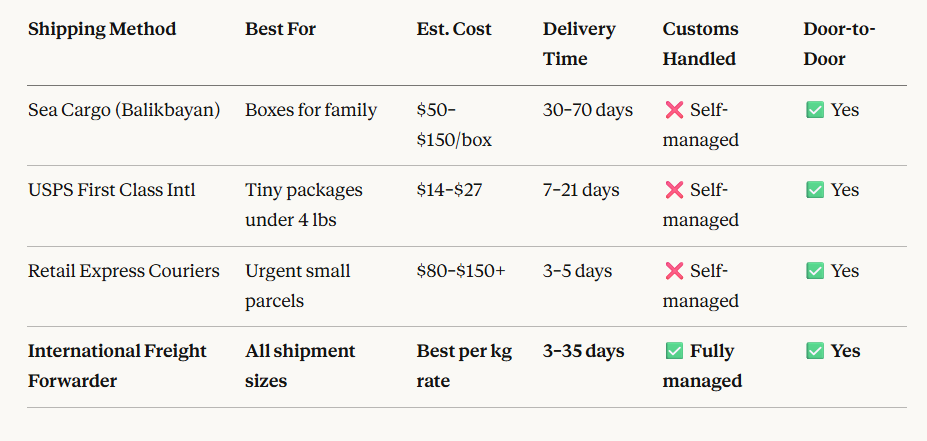
Notice the difference in the customs column. With retail carriers, any issues at Philippine customs are yours to figure out, and that can mean delays, unexpected fees, or worse, a held shipment.
An international freight forwarder handles all of that on your behalf, so your shipment moves cleanly from the US to your recipient's door without surprises.
Air vs. Sea, Which One Should You Choose?
This is the question most shippers struggle with. The honest answer is — it depends on two things: how heavy is your shipment and how soon does it need to arrive.
Here's a simple way to think about it:
- Choose sea cargo if:
- Your shipment is heavy or bulky — think full Balikbayan boxes, furniture, appliances, or business inventory
- You're not in a rush and can wait 30–60 days
- Saving money is the top priority over speed
- You're shipping regularly and want the lowest cost per kilogram
- Choose air freight if:
- Your shipment is time-sensitive or urgent
- You're sending smaller, lighter packages
- The value of the contents justifies the faster delivery
- Your recipient needs it within the week
The hidden truth most shippers don't know, the line between air and sea isn't always as expensive as people think.
For heavier shipments, air freight through the right channels can be surprisingly competitive, especially when customs, handling, and last-mile delivery are all bundled into one cost rather than billed separately as surprise fees.
This is why experienced shippers rarely make the air vs. sea decision alone — they consult someone who knows both markets and can tell them which option genuinely saves more for their specific shipment.
Philippine Customs — What You Need to Know
Customs is where a lot of shipments get delayed, held, or hit with unexpected fees. And in 2026, it's more important than ever to get this right before your package leaves US soil.
The Rules Keep Changing
- Philippine customs regulations have been evolving steadily over the past few years. The Bureau of Customs (BOC) has been actively updating its policies — from revised duty-free thresholds to stricter documentation requirements and tighter enforcement on undervalued shipments.
- What was acceptable last year may not be today, and relying on outdated information is one of the most common and costly mistakes shippers make.
Tariff Rates Are Not One-Size-Fits-All
- Import duties in the Philippines vary significantly depending on what you're shipping, how it's classified, and where it's coming from.
- The same item can fall under different tariff categories depending on how it's declared — and an incorrect classification can trigger delays, penalties, or outright confiscation at the port.
Prohibited and Restricted Items
- Certain items cannot enter the Philippines under any circumstances, while others require special permits or prior clearance.
- This list is also subject to change, so assuming something is allowed based on a quick online search is a risk not worth taking.
Customs is not the place to guess. Given how frequently regulations shift, the safest and smartest move is to consult with a licensed customs broker before you ship.
They know the current rules, the correct tariff classifications, and exactly what documentation is needed to keep your shipment moving without interruption.
Pro Tips to Save More on Every Shipment
Knowing which shipping method to use is just the first step. These practical tips can shave even more off your shipping bill — and help you avoid the hidden costs that catch most shippers off guard.
Consolidate Your Shipments
- One of the biggest money-saving moves you can make is combining multiple smaller shipments into one.
- Instead of sending three separate boxes at different times, consolidating them into a single shipment significantly reduces your cost per kilogram.
- This is something most individual shippers can't easily do on their own — but it's standard practice in the international freight forwarding world.
Ship Off-Peak
- Shipping costs spike during peak seasons — Christmas, summer, and major Philippine holidays.
- If your shipment isn't time-sensitive, planning around these periods can result in meaningful savings.
- Even shifting your schedule by a few weeks can make a noticeable difference.
Pack Smart to Reduce Dimensional Weight
- Carriers don't just charge by actual weight — they also calculate dimensional weight based on the size of your package.
- A large, lightly packed box can end up costing more than a smaller, heavier one. Pack tightly, use the right box size, and eliminate dead space wherever possible.
Always Compare Before You Book
- Retail carrier rates are not fixed — they fluctuate based on volume, season, and routing. Never book the first rate you see.
- Taking time to compare options across different services and channels almost always reveals a better price for the same shipment.
Understand the True Total Cost
- The quoted shipping rate is rarely the final number. Fuel surcharges, handling fees, customs clearance costs, and last-mile delivery charges can add up quickly.
- Always ask for a full cost breakdown before committing — a slightly higher base rate that includes everything is often cheaper than a low headline rate with fees stacked on top.

Conclusion
Shipping from the USA to the Philippines in 2026 has more options than ever — but more options also means more room to overpay if you're not careful.
The difference between a costly shipment and a smart one often comes down to who you trust to get it there.
So always ship smarter and ship with the one who knows the right and cost effective way.
Frequently Asked Questions
1. What is the cheapest way to ship from the USA to the Philippines in 2026?
The cheapest option depends on what you're sending. For large, heavy shipments with no time pressure, sea cargo is the most affordable route. For smaller packages, budget air services offer competitive rates. However, for anyone shipping regularly or in volume, working with an international freight forwarder consistently delivers the best cost per kilogram — with the added benefit of customs handling and end-to-end management included.
2. How long does shipping from the USA to the Philippines take?
It depends on the method. Sea cargo typically takes 30–60 days, standard air freight around 7–21 days, and express air services can deliver in as little as 3–5 business days. Transit times can also vary depending on customs clearance speed on the Philippine end.
3. What items are prohibited from shipping to the Philippines?
The list of prohibited and restricted items is updated regularly by the Bureau of Customs. Because this changes frequently, it's always best to verify with a licensed customs broker before shipping rather than relying on outdated information online.
4. Why does my shipment get held at Philippine customs?
The most common reasons are incomplete documentation, incorrect item declarations, missing permits for restricted goods, and undervalued shipments. Most of these issues are entirely preventable with proper preparation before your package leaves the US.
5. Is sea or air cargo cheaper for shipping to the Philippines?
Sea cargo is cheaper per kilogram for heavy and bulky shipments. Air freight costs more but gets your shipment there faster. The right choice depends on your timeline and the nature of what you're sending — and in some cases, air freight through the right channels can be more competitive than people expect.
6. Do I need a customs broker to ship to the Philippines?
Technically no — but practically, yes. Philippine customs regulations change frequently, tariff classifications are complex, and a single documentation error can hold your shipment for days or weeks. A customs broker ensures everything is compliant from the start, saving you time, money, and unnecessary stress.
7. What is an international freight forwarder and why should I use one?
A freight forwarder acts as your shipping expert — coordinating carriers, managing documentation, handling customs, and overseeing your shipment from origin to destination. Rather than navigating the complexity of international shipping alone, you have a dedicated professional doing it on your behalf, often at better rates than you could access directly.