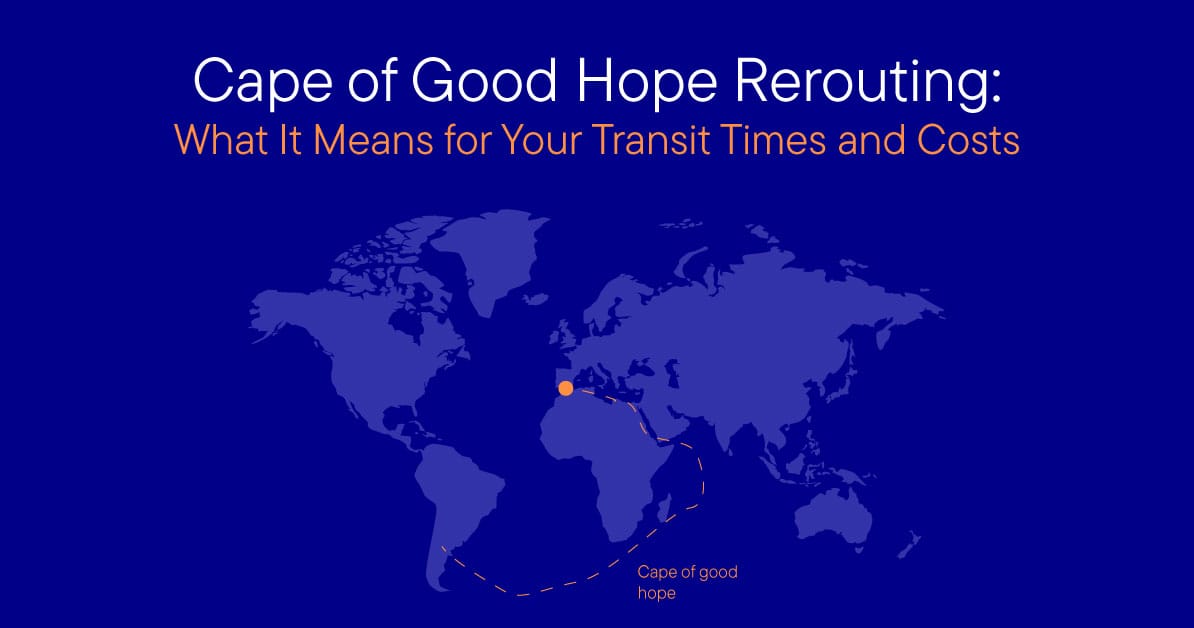
A few months ago, the Cape of Good Hope was a geography lesson. Now it's your shipping route.
With the Strait of Hormuz under military threat and Suez-adjacent lanes too risky for most carriers, vessels are being pushed thousands of miles south — around the entire bottom of Africa — just to get your cargo from point A to point B.
Maersk is doing it. Hapag-Lloyd is doing it. And if your freight moves anywhere near the conflict zone, your carrier is probably doing it too.
The result? Longer transit times. Higher freight bills. And a whole lot of confusion about what this actually means for your specific shipments.
This blog breaks it down in plain numbers — how much time the Cape reroute adds, how much more it costs, which lanes are hit the hardest, and what you can actually do about it before your margins disappear completely.
Why Is My Shipment Going Around Africa?
Short answer — because the usual shortcut isn't safe anymore.
Most cargo moving between Asia, the Middle East, and the US or Europe normally passes through the Strait of Hormuz and the Suez Canal. It's faster. It's cheaper. It's been the default for decades.
But the recent geopolitical developments changed that. Military operations, naval blockades, and mine threats in and around Hormuz have made that route too dangerous for commercial vessels.
Carriers can't get insurance for it. So they won't sail through it.
The alternative? Go south. Way south. Around the entire bottom of Africa via the Cape of Good Hope — then back up the other side toward your destination.
It's a massive detour. But right now, it's the safest and most reliable path your cargo can take.
This isn't your carrier being difficult. This isn't a scheduling error. This is the global shipping industry doing the only thing it can until the conflict zone clears.
How Much Longer Will My Shipment Take?
Here's what the reroute actually adds to the most common US-bound lanes:
Disclaimer - These are estimates. Actual times depend on your carrier, port congestion, and whether your vessel makes additional stops along the way.
But as a rule — expect your shipment to take roughly two to three weeks longer than what you're used to.
How Much More Will It Cost?
This is the part that hurts. The reroute doesn't just add time — it adds fuel, labor, insurance, and a stack of surcharges to every shipment.
Here's how each cost factor is shifting:
- Freight rates have jumped 30–50% on affected lanes. So if you were paying $3,000 per container on an Asia-to-US lane, you're now looking at $4,000 to $4,500 for the same shipment. If you were paying $5,000, expect $6,500 to $7,500.
- Fuel surcharges are up 15–25% because the Cape route adds roughly 3,000 to 4,000 extra nautical miles. More distance means more fuel. If your fuel surcharge used to be $400 per container, it's now closer to $500 to $600. Carriers aren't eating that difference — it's landing on your invoice.
- War-risk and conflict surcharges are brand new line items that didn't exist on your invoice before this crisis. If your carrier was charging zero for this, you're now seeing $200 to $800 per container depending on your origin port and lane.
- Port congestion fees are showing up more frequently. Ports along the Cape route — especially in South Africa and West Africa — weren't built to handle this volume of rerouted traffic. If congestion fees were rare on your lane before, expect them to become a regular line item now.
The simple math? Take whatever you were paying per container last quarter. Add 30–50% on top of that. That's your new baseline — and it's not coming back down the moment the conflict ends. Carriers will keep surcharges in place until routes fully normalize. That takes months, not days.
So What Are My Options Right Now?
You can't make the war stop. You can't reopen Hormuz. But you're not powerless either. Here's what's actually within your control right now.
Option 1: Stay on the Cape Route — But Plan Around It
- The Cape reroute is slower and more expensive but it's predictable. Vessels are moving. Cargo is arriving.
- It's just taking longer. If your shipments aren't time-sensitive, the smartest move might be to accept the new timeline and adjust everything around it.
- Push your reorder dates forward. Notify your customers about updated delivery windows.
- Build the extra transit time into your planning instead of treating every shipment like a surprise.
Option 2: Switch to Transpacific Lanes Where Possible
- If your cargo originates in Asia — especially India, Southeast Asia, or China — ask your forwarder about eastbound transpacific routing instead of westbound through Suez or the Gulf.
- Your shipment moves across the Pacific to the US West Coast and then connects inland by rail or truck.
- It avoids the conflict zone entirely and in some cases the transit time is comparable to the Cape detour — sometimes even faster.
Option 3: Go Air Freight for Urgent Shipments
- If you have high-value or time-critical cargo that can't afford a three-week delay, air freight is your emergency lever.
- Yes, it costs significantly more per kilo. But if the cost of a late delivery — lost sales, production shutdown, contract penalties — is higher than the air freight premium, it makes financial sense. Use it selectively, not for everything.
Option 4: Split Shipments Across Multiple Routes
- Don't put all your cargo on one vessel on one lane. Break larger orders into smaller shipments and spread them across different carriers and routes.
- If one gets delayed, the others still land. It's not the cheapest approach but it dramatically reduces your risk of a total delivery failure.
Option 5: Talk to Your Freight Forwarder. Seriously
- This isn't a sales pitch. This is practical advice. A good forwarder has real-time visibility on which lanes are moving, which ports are congested, which carriers have space, and which routes are giving the best transit times right now.
- They're seeing hundreds of shipments across dozens of lanes every week. You're seeing yours. That information gap is where you either save money or lose it.
- If your forwarder isn't proactively calling you with alternatives and updates during this crisis — that tells you everything you need to know.
At Air7Seas, this is exactly what we've been doing since the day the reroutes started. When the Cape detour added three weeks to a client's Mumbai-to-New York lane, we found a transpacific alternative that cut seven days off the delay.

When surcharges started piling up on another client's invoices, we audited every line, challenged the charges that didn't apply, and locked in a contract rate before the next hike.
That's not special treatment. That's what your international freight forwarder should already be doing for you.
If they're not — and you're tired of figuring this out alone — we're offering free consultations for US importers affected by the reroutes.
No pressure. Just a clear look at your lanes, your costs, and your options
Frequently Asked Questions
1. How long will the Cape of Good Hope reroute last?
Nobody knows for sure. It depends entirely on when the conflict around the Strait of Hormuz de-escalates enough for carriers and insurers to greenlight commercial traffic again. That could be weeks. It could be months. Plan as if it's months — and be pleasantly surprised if it's shorter.
2. Will my carrier automatically reroute my shipment or do I need to request it?
Most major carriers have already made the decision to reroute. You don't need to request it. But you do need to confirm with your forwarder exactly which route your specific shipment is taking — because not every vessel follows the same path and transit times vary depending on the stops along the way.
3. Can I refuse the reroute and wait for the original lane to reopen?
Technically you can hold off on shipping. But your cargo doesn't move until a safe route is available — and nobody can tell you when that will be. Waiting means your inventory sits, your customers wait, and your competitors who kept shipping take your market share. Waiting is an option. It's just not a good one.
4. Why am I seeing different surcharges from different carriers for the same route?
Because there's no standard. Every carrier sets their own war-risk premiums, fuel adjustments, and conflict surcharges based on their own cost structure and risk models. That's why the same lane can show a $300 difference between two carriers. This is exactly where comparing quotes and having a forwarder negotiate on your behalf saves real money.
5. Is the transpacific route always faster than the Cape reroute?
Not always — but in many cases, yes. For cargo originating in India, Southeast Asia, or China, going east across the Pacific to the US West Coast can be comparable or even faster than the Cape detour heading west around Africa. It depends on your origin port, destination, and carrier availability. Ask your forwarder to run the comparison for your specific lane.
6. Should I switch to air freight for all my shipments?
No. Air freight makes sense for high-value, time-critical, or low-volume cargo where the cost of delay is higher than the cost of flying it in. For everything else, it's too expensive to sustain. Use it as a surgical tool for your most urgent shipments — not as a blanket replacement for ocean freight.
7. Will shipping costs go back to normal once the conflict ends?
Not immediately. Even after the conflict winds down, it takes months for routes to normalize, port congestion to clear, surcharges to be rolled back, and carrier schedules to stabilize. If you're waiting for pre-war pricing before you make a move, you'll be waiting a long time. The smarter play is to optimize within today's reality instead of banking on a return to yesterday's rates.